Background Story
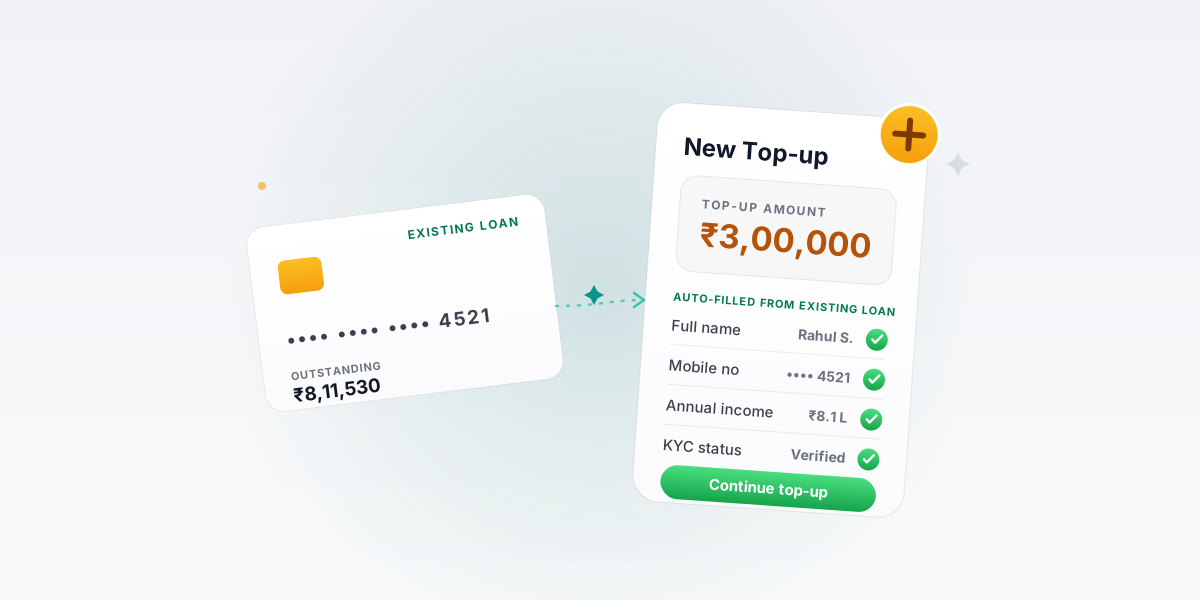
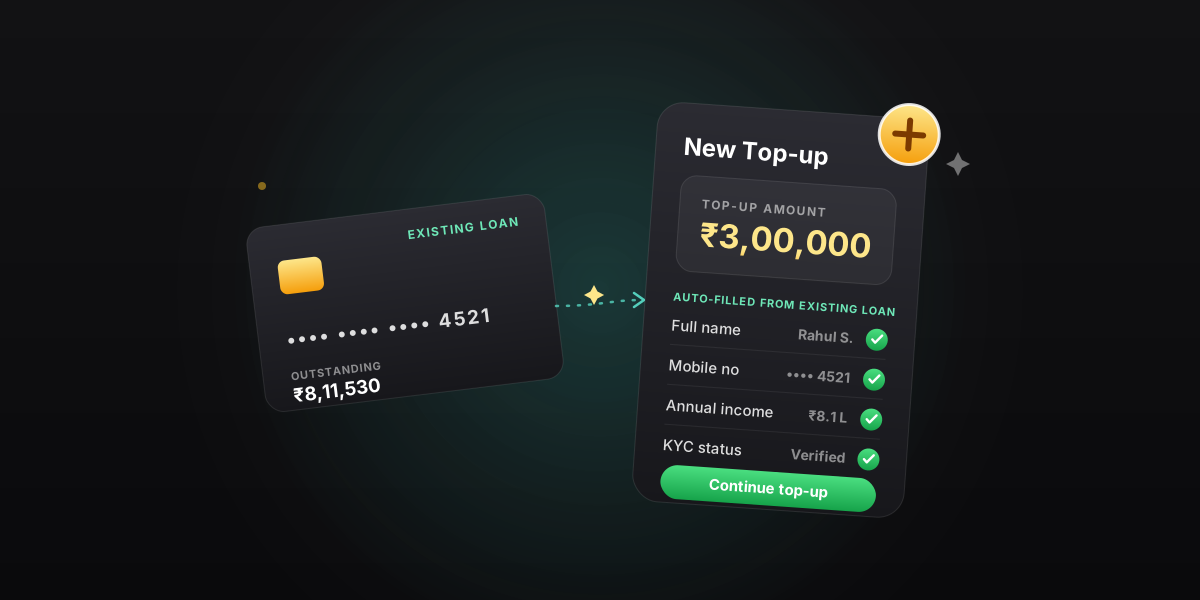
Existing UBL customers often required additional funding as their businesses grew.
However, Sales Central had no dedicated top-up journey.
To process a top-up request:
- RM had to create a brand-new lead
- Re-enter customer information
- Repeat data collection
- Restart several steps already completed in previous loans
This created operational inefficiencies and a fragmented experience.
Problem Understanding
For RMs:
- Repetitive manual work
- Multiple screens and data entry
- Longer processing time
- Increased chance of errors
For Business:
- Lower productivity
- Increased operational cost
- Longer turnaround time
- Missed opportunity to leverage existing customer data
For customers:
- Additional effort for information already available within the organization
Research
As the sole UX designer, I:
- Conducted workflow analysis
- Studied existing lead creation journey
- Identified inefficiencies in the top-up process
- Facilitated discussions with Product and Engineering teams
- Explored multiple solution directions
- Created both immediate and future-state experiences
- Aligned business and technical stakeholders
Understanding the Current Process
Key Observation
The organization already possessed customer and loan information, yet the system required RMs to recreate the customer journey from the beginning.
This indicated a gap between available data and the user experience.
Opportunity Discovery
"Why are we asking Relationship Managers to recreate information that already exists within our systems?"
This became the central design challenge.
I connected with the BIU team and checked what data we get for an existing lead, then grouped it to show on screen
| 1FIRST_NAME | 14UTM_ID | 27DETAILS_OF_CUSTOMER |
| 2LAST_NAME | 15CUSTOMER_STATE | 28PROPERTY_IDENTIFIED |
| 3MOBILE_NO | 16PIN_CODE | 29PROPERTY_LOCATION |
| 4LOAN_PRODUCT | 17FOLLOW_UP_DATE_AND_TIME | 30PROPERTY_TYPE |
| 5LOAN_AMOUNT | 18COMPANY_NAME | 31PROPERTY_ZONE |
| 6STAFF_EMPLOYEE_CODE | 19ANNUAL_INCOME | 32DATE_OF_LEAD_CAPTURE |
| 7LEAD_SOURCE | 20ANNUAL_OTHER_INCOME | 33LEAD_TYPE |
| 8CUSTOMER_CITY | 21MONTHLY_OBLIGATION | 34REMARKS |
| 9GENDER | 22REQUESTED_ROI | 35LEAD_SUB_SOURCE |
| 10BRANCH | 23RM_EMPLOYEE_CODE | 36RESULT |
| 11CUSTOMER_OCCUPATION | 24RM_MOBILE_NUMBER | 37LEAD_ID |
| 12PARTNER_TYPE | 25LEAD_QUALIFIED | 38REASON |
| 13PARTNER_EXTERNAL_ID | 26LEAD_DISQUALIFICATION_REASON |
Data Fetched from LAN no.
Data Grouping
| Basic Details | Income Details | Loan Details |
|---|---|---|
| 1FIRST_NAME | 1ANNUAL_INCOME | 1LEAD_ID |
| 2LAST_NAME | 2ANNUAL_OTHER_INCOME | 2LOAN_PRODUCT |
| 3MOBILE_NO | 3MONTHLY_OBLIGATION | 3LOAN_AMOUNT |
| 4CUSTOMER_CITY | 4LEAD_SOURCE | |
| 5GENDER | 5LEAD_SUB_SOURCE | |
| 6CUSTOMER_OCCUPATION | 6LEAD_TYPE | |
| 7CUSTOMER_STATE | 7REQUESTED_ROI | |
| 8PIN_CODE |
Key Screens & Design Decisions — Internal Top-up
Solution Exploration
Evaluated the existing top-up loan process, identified gaps across internal and external customer scenarios, and proposed scalable journey designs that balanced user needs, business objectives, and technical constraints.
Internal UBL Top-up
Designs
Key Screens & Design Decisions — External Top-up
External UBL Top-up
User Flow
Designs
Solution Alignment with tech and product
While defining the top-up journey, the initial product requirement proposed asking Relationship Managers to enter the Loan Account Number (LAN) after selecting a lead and then fetching customer details.
After analyzing the workflow, I identified that this step introduced unnecessary effort and friction. Since the system already had access to the customer's loan information, asking RMs to manually enter the LAN provided no additional value. Additionally, field research and stakeholder discussions revealed that neither customers nor Relationship Managers typically remembered the LAN, making it an unreliable input.
Stakeholder Challenge
The ideal solution depended on access to lead-based data.
However:
- BIU team was not exposing required data
- Integration dependencies existed
- Technical feasibility was limited in the current release
Instead of abandoning the vision, I:
- Documented the ideal experience
- Worked with Product and Engineering teams
- Proposed a phased approach
- Created a scalable blueprint for future implementation
To align stakeholders on a more user-friendly approach, I:
- Evaluated the proposed flow and identified redundant user actions.
- Mapped the data already available within the system to understand opportunities for automation.
- Demonstrated how manual LAN entry increased effort without improving business outcomes.
- Advocated for a "system-first" approach where relevant customer and loan details are automatically surfaced.
- Collaborated with Product Managers & tech to align the solution with business objectives while reducing operational friction.
- Worked closely with Engineering teams to understand data dependencies and technical feasibility.
- Presented the impact on RM productivity and workflow efficiency to support the design recommendation.
- Facilitated discussions across Product and Technology teams to build consensus around the revised approach.
- Aligned stakeholders on an experience that minimized manual input and leveraged existing customer data wherever possible.
Outcome: The team aligned on a simplified top-up journey that removed unnecessary LAN entry and focused on reducing effort for Relationship Managers while maintaining business and technical requirements.
Business Impact (Till December)
Reflection & Learnings
WHAT I DID WELL
- Identified that the core challenge was not just designing a Top-up journey, but addressing underlying operational and system dependencies impacting RM efficiency.
- Looked beyond immediate feature requirements and defined a future-state vision focused on data integration and automation.
- Proactively collaborated with developers early to validate technical feasibility before proposing solutions.
- Balanced user needs, business goals, and system constraints to create a scalable and practical experience.
- Influenced stakeholders by shifting discussions from feature delivery to long-term workflow optimization and operational efficiency.
WHAT I WOULD DO DIFFERENTLY
- Would engage dependent teams earlier in the discovery phase to validate data availability, integrations, and system constraints.
- Recognized that several solution directions relied on external systems, making early cross-functional alignment critical.
- Would establish clearer prioritization between immediately feasible improvements and longer-term strategic enhancements from the outset.
- Learned the importance of aligning technical dependencies early when designing experiences that span multiple systems and teams.
WHERE I STRUGGLED
- Several high-impact solutions depended on data-sharing and architectural support from teams outside the project's scope.
- Navigated technical and operational constraints while ensuring meaningful improvements could still be delivered.
- Facilitated ongoing discussions with Product, Engineering, and dependent teams to evaluate trade-offs and feasibility.
- Learned to drive progress through phased improvements while maintaining a clear vision for the ideal future-state experience.